About RetinaFace
A small team with one goal: make accurate, open face detection something anyone can download and trust.
Who we are
RetinaFace is maintained by a group of computer-vision engineers, educators and open-source contributors who kept running into the same wall: most free face detectors fell apart the moment a face was small, turned away from the camera, or caught mid-motion. We wanted a detector that stayed dependable in exactly those situations, and we wanted it to be free for everyone — so we built and now maintain RetinaFace in the open.
Why RetinaFace exists
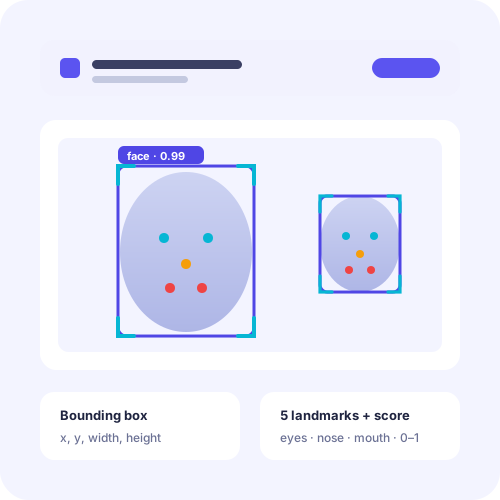
Face detection sits at the start of countless projects, from classroom demos to research pipelines to camera apps. When the detector is unreliable, everything built on top of it inherits that weakness. RetinaFace was created to remove that uncertainty. By returning a bounding box, five facial landmarks and a confidence score for every face, it gives builders the raw material they need and the honesty to know how much to trust each result.
What we stand for
Three commitments guide the project. First, accuracy where it's hard — we measure success on the difficult images, not the easy ones. Second, openness — the code is MIT-licensed and auditable, with no hidden fees, accounts or telemetry. Third, approachability — a researcher should be able to script it, and a first-year student should be able to open the demo app and see it work the same afternoon.
Experience you can lean on
The people behind RetinaFace have shipped detection systems for academic research, consumer apps and live camera tooling. That experience shapes every release: realistic defaults, sensible thresholds, clear documentation and guides written by people who have debugged these exact problems. We treat the project as a long-term responsibility, not a weekend experiment, which is why each version is tested across Windows, macOS and Linux before it ships.
How to reach us
We read every message. Whether you have found a bug, want to suggest an improvement, or simply need help getting started, write to us at info@retinaface.com. Feedback from students, developers, researchers and educators is what keeps RetinaFace sharp — and free.