Pinpoint accuracy
Finds small, side-on and partly hidden faces that lighter detectors routinely skip.
RetinaFace is a fast, lightweight face detector that locates faces, marks five facial landmarks and scores its confidence — on small, blurry or angled faces other tools miss. Free to download for Windows 11, macOS and Linux.
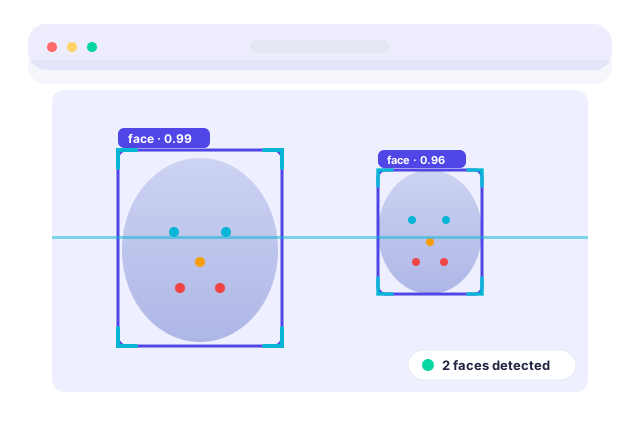
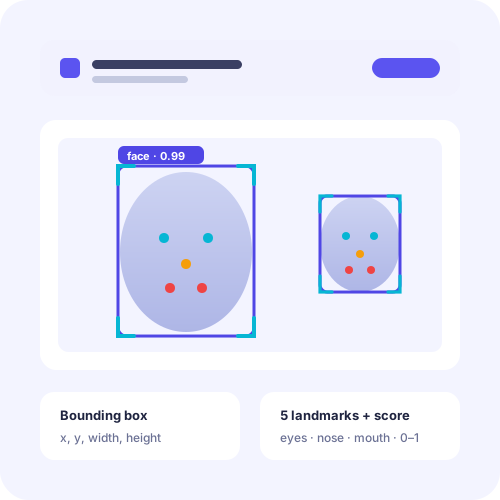
RetinaFace is an open-source face detection tool that answers one question reliably: where are the faces in this image? Instead of just drawing a box, it pinpoints five key facial landmarks and attaches a confidence score to every result, so you always know how sure the detector is.
It was created because everyday detectors struggle the moment faces get small, turn sideways or blur in motion. RetinaFace was designed to stay accurate exactly there — in crowds, security footage and candid photos — while remaining light enough to run on an ordinary laptop.
Nine reasons RetinaFace has become a go-to choice for face detection across teaching, research and production work.
Finds small, side-on and partly hidden faces that lighter detectors routinely skip.
Returns eyes, nose tip and mouth corners for alignment, pose and effects.
Every detection carries a score so you can filter out anything uncertain.
Lightweight enough for live webcam detection, frame after frame.
One detector, identical results on Windows 11, macOS and Linux.
Add a CUDA GPU to speed up real-time and batch workloads.
Detects every face in a frame in a single pass, even in busy scenes.
Runs fully offline after setup, so images never leave your machine.
MIT-licensed and auditable, with no fees, accounts or hidden limits.
The latest stable build, ready for Windows 11, macOS and Linux. No sign-up, no payment.
The full toolkit — detector, pre-trained weights and a no-code demo app so you can confirm detection works the moment it opens.
Virus-scanned · open-source · safe to install
From download to your first detection, RetinaFace installs in minutes — no machine-learning background required.
Grab the latest RetinaFace build for your operating system from the download section above. The file is about 86 MB.
Run the installer and follow the prompts, or unzip the portable build into any folder you like — no admin rights needed for the portable version.
Launch RetinaFace and let it cache the model weights on first start. This one-time step prepares the detector for fast results.
Drop in an image or enable your webcam. RetinaFace draws boxes and landmarks and shows a confidence score for every face it finds.
RetinaFace processes the whole image at once and hands back exactly what downstream tasks need.
Feed a photo, a frame or a live webcam stream into the detector.
The model scans the full frame once, no slow multi-step pipeline.
Each face gets a bounding box and five precise landmark points.
A score per face lets you keep strong detections and drop the rest.
Tested across desktop platforms and common hardware so you know what to expect before you download.
| Platform | Minimum | Recommended | Status |
|---|---|---|---|
| Windows 11 / 10 | 4 GB RAM, dual-core CPU | 8 GB RAM, CUDA GPU | Full support |
| macOS 12+ | 4 GB RAM, Apple silicon or Intel | 8 GB RAM, Apple silicon | Full support |
| Linux (Ubuntu / Debian) | 4 GB RAM, x86-64 | 8 GB RAM, NVIDIA GPU | Full support |
| Older 32-bit systems | Not available | — | Limited |
No tool is perfect. Here is where RetinaFace shines and where you should plan ahead.
Spot and align faces at entrances or in classrooms before a recognition step takes over.
Auto-detect faces to group, crop or tag large photo libraries quickly.
Extract and align faces at scale to prepare clean training data.
Use the landmarks to anchor filters, masks and live overlays in real time.
Count and locate faces in busy footage for crowd and safety analytics.
A hands-on, free tool for students learning how detection really works.
Most issues clear in a minute. For deeper help, see the troubleshooting guide.
Let the first run finish caching the model weights, and make sure your antivirus isn't blocking the app folder. Reopen RetinaFace once caching completes.
Switch to the MobileNet backbone, lower the input resolution, or enable a CUDA GPU. Each option trades a little accuracy for noticeably faster frames.
Raise the confidence threshold — try 0.8 instead of 0.5. Detections below the threshold are dropped, which removes most weak matches.
Rated 4.8 out of 5 across 1,742 reviews.
“It handled a crowded lecture-hall photo that two other detectors gave up on. The landmarks saved me a whole alignment step.”
“Installed the portable build on a locked-down lab machine in under five minutes. My students were detecting faces the same afternoon.”
“The confidence score is the feature I didn't know I needed. Threshold at 0.85 and my false positives basically vanished.”
Twenty answers covering setup and everyday detection. Still stuck? Reach the team at info@retinaface.com.
Download RetinaFace free, run it offline, and get boxes, landmarks and confidence scores from your very first image.
Download RetinaFace 2.4.1